
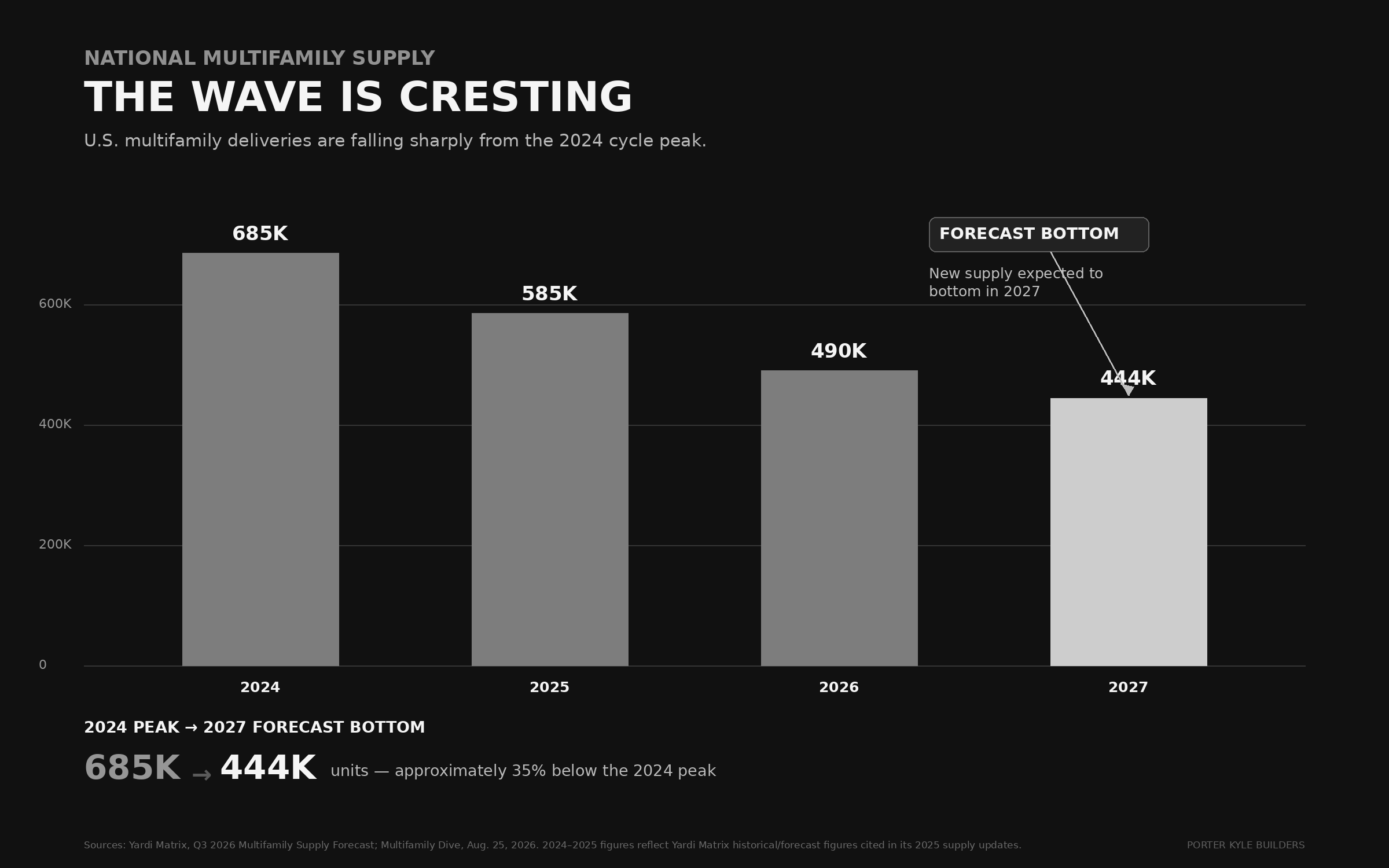
The U.S. apartment market is regaining its footing, but unevenly. Rent growth is accelerating, the historic construction wave that defined the past three years is finally receding, and supply is on track to bottom out in 2027. For Sun Belt metros like Phoenix that absorbed the brunt of that building boom, the data increasingly points to a market working through its supply overhang rather than being overwhelmed by it.
Renting Keeps Winning the Affordability Math, With a Caveat
The for-sale market’s challenges are, on paper, good news for apartment demand. The average 30-year fixed mortgage rate climbed to 7% this month, its highest point in more than a year, per Freddie Mac data. That increase sharpens the dilemma confronting would-be homebuyers: comfortably affording the typical U.S. rental requires roughly $78,488 in annual income, versus nearly $99,800 to buy a typical home. Yardi Matrix’s forecast leans into that dynamic, projecting that elevated long-term rates will keep constraining single-family housing activity and pushing would-be buyers toward renting.
Economists note a caveat, however: rent growth didn’t reaccelerate the last time mortgage rates spiked, and historically, stronger home-sales environments have actually helped apartment operators backfill move-out units faster, and at higher rents, by driving the broader economic activity that supports rental demand. The rate environment is a supporting factor for multifamily, not a guaranteed tailwind on its own.
A National Inflection Point
Driven by a robust spring leasing season, U.S. apartment absorption exceeded 187,000 units in Q2, reported researchers at RealPage. Demand totaled roughly 271,300 units in the year-ending second quarter, below the decade average of about 340,000 units. According to Yardi Matrix’s August Multifamily National Report, the national average advertised apartment rent rose $2 in August to $1,773, with year-over-year growth accelerating to 0.4%, the fastest pace in nearly a year.
Multifamily permits are running 31% below their 2022 peak, and deliveries over the year ending in Q2 totaled roughly 340,200 units, below the decade average for the first time in about three years. First-half 2026 deliveries fell 41.3% year-over-year to 203,073 units nationally. The pullback is broadest in the South, which posted the lowest share of any U.S. region with metros authorizing more multifamily units than a year earlier, per Chandan Economics/Arbor Realty Trust, an early signal that the slowdown already showing up in Phoenix and its Sun Belt peer markets should continue.
Yardi Matrix’s Q3 2026 Multifamily Supply Forecast puts a number on where that trend lands: new supply is set to bottom out in 2027 at roughly 444,343 units nationally, with only marginal expansion through 2031, well below the elevated deliveries of 2024 and 2025.
What’s Actually Holding Phoenix Back, and Why That’s Changing
Phoenix rents remain negative, down 1.6% year-over-year as of August per Yardi Matrix, with occupancy at 93.2%. Part of the explanation is sheer volume: Phoenix ranked second nationally for multifamily deliveries in the first half of 2026 at 11,350 units, trailing only Dallas. Unlike Austin or Dallas, Phoenix’s delivery pace has eased only modestly, down 12.5% year-over-year and still above first-half 2024 volume, putting the metro in the later innings of an unusually active supply cycle rather than an early, sharp pullback. Phoenix also has roughly 42,286 units in lease-up, the second-highest total among Yardi Matrix’s top 30 markets. Lease-up volume, not weak demand, is the single biggest factor correlated with soft rent growth across the Sun Belt right now.
Still, the trend lines are moving the right way. Phoenix posted its first positive trailing three-month rent reading since May 2024 this spring, and construction starts declined a moderate 10.5% year-over-year. Nationally, units in lease-up have fallen to 1.2 million as of August, down from a peak of 1.4 million in early 2025, and the South’s comparatively fast construction timeline (17.5 months on average from authorization to completion, versus 21.9 in the Northeast) means Phoenix and its Sun Belt peers should see that pipeline clear faster than slower-building regions.
BTR Holds Its Ground, and Phoenix Remains in the Mix
The build-to-rent sector offers a useful counterpoint, and Phoenix remains squarely in it. SFR/BTR starts totaled 63,000 units nationally over the year ending in Q2 2026, down 16% from a year earlier, per Arbor Realty Trust/Chandan Economics and NAHB analyses of Census data. The pullback stems from higher financing costs, rising multifamily supply, and, until recently, uncertainty over pending federal legislation. That uncertainty has since cleared: the 21st Century ROAD to Housing Act as enacted does not prohibit institutional capital from financing BTR housing, and Yardi Matrix characterizes it as providing “ample supply-side incentives for multifamily investment and new development.” BTR still holds just under 7% of single-family starts nationally, well above its historical average.
RealPage projects BTR deliveries will peak at roughly 40,800 units nationally by year-end before contracting sharply through 2029. Nearly 60% of the national BTR pipeline sits in the South, and Phoenix ranks among the leading markets for both current construction and the next wave of planned projects, meaning the metro carries real near-term supply to absorb but is also positioned to benefit disproportionately as deliveries taper industry-wide.
Looking Ahead
The story for Phoenix and its Sun Belt peers isn’t that the reset is finished, it’s that the mechanics behind it are becoming clearer, and 2027 is emerging as the consensus turning point across multiple forecasts. A shrinking lease-up pipeline, moderating construction, a BTR sector positioned to tighten, and a national supply outlook bottoming out next year are converging into a more constructive setup for the year ahead.