
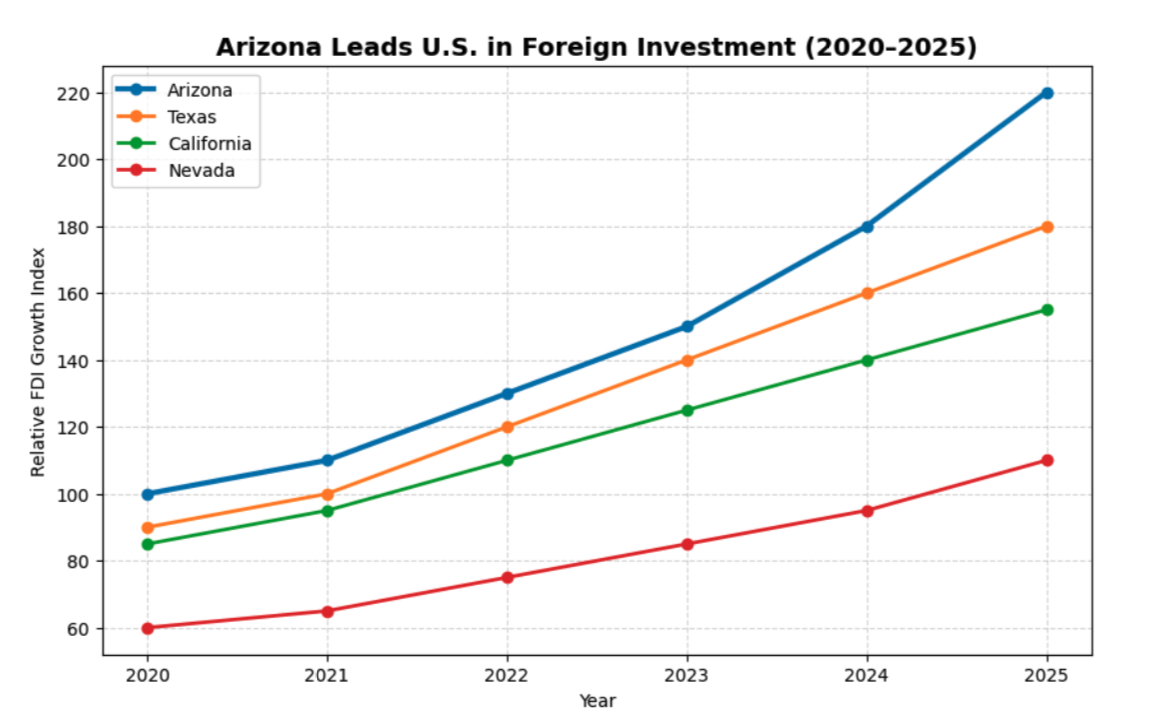
Sources: Arizona Commerce Authority – International Trade & Foreign Direct Investment Reports (2020–2025) / fDi Markets (by Financial Times) – U.S. state FDI project tracking and rankings / Bureau of Economic Analysis – Foreign Direct Investment in the United States (FDIUS) datasets / Greater Phoenix Economic Council – Regional investment announcements and summaries
Phoenix—and Arizona more broadly—continues to solidify its position as one of the most dynamic growth markets in the U.S. What’s happening in the desert right now isn’t just cyclical momentum—it’s structural transformation. From advanced manufacturing to global trade and next-generation talent, the state is building an economy that looks very different than it did even five years ago.
Arizona’s economy of late is performing at a remarkable rate. Let’s start with the big picture: from 2020 to 2025, Arizona led all states as the top destination for international investment, with more than $195.7 billion announced. That’s not a typo. Number one in the entire country. And it’s not slowing down — in 2025 alone, Arizona attracted 55 foreign direct investment projects totaling $107.7 billion and more than 25,000 projected new jobs.
A huge driver of this is what people are calling the “TSMC effect.” The Taiwanese chipmaker has committed $165 billion to its Arizona operations, and the ripple effects are being felt everywhere — from high-tech job creation to shopping centers filling up near their North Phoenix campus. And the latest news takes that relationship even further: Apple recently announced plans to purchase 100 million chips from TSMC’s Arizona fab, a major vote of confidence in domestic semiconductor production.
On the trade front, the numbers are just as striking. Exports by Arizona companies surged from $32.4 billion to $44.4 billion in 2025 — a 37% increase and the second fastest export growth rate in the nation, compared to just 5.7% growth nationally. Taiwan surpassed both Canada and China to become Arizona’s second-largest trading partner behind Mexico, with total trade exceeding $21.2 billion. That’s a seismic shift in Arizona’s global trade relationships, and it happened in just one year.
Arizona is also making moves to lock in those partnerships for the long term. In March 2026, the State of Arizona, the City of Kaohsiung in Taiwan, and Kumamoto Prefecture in Japan signed a trilateral Memorandum of Understanding to strengthen collaboration in semiconductors, talent development, research and development, and global supply chain integration. This is significant — all three regions are home to major TSMC facilities, making them natural allies in building a more resilient global chip supply chain. Since 2020, Arizona has attracted more than $214 billion in semiconductor investments and over 70 industry expansions, creating roughly 25,000 new high-quality jobs and establishing one of the most complete semiconductor ecosystems in North America.
Back home, the job market is keeping pace. The University of Arizona’s Eller College of Management projects job growth to rebound to 2.1% in 2025, with unemployment remaining low at around 4%, signaling strong, broad-based demand. Arizona is outpacing the nation on both income and hiring — even as U.S. job growth has stumbled in other parts of the country. Semiconductor-related engineering and management roles are lifting average earnings, with high-skill positions tied to hardware and manufacturing posting median wages above $160,000.
Phoenix is doing the heavy lifting as Arizona’s economic engine, but the momentum extends across the Valley. In fiscal year 2025, Arizona hit a record 24,285 new jobs created, fueled by more than $31 billion in investment, spanning sectors from semiconductors and aerospace to AI, battery manufacturing, and bioscience. Data centers and AI infrastructure are also pumping billions into the region, adding another layer of long-term growth to the story.
And the next generation is taking notice. Phoenix now ranks as the top U.S. city for startups among cities with over one million residents — and city and state leaders are doubling down on that momentum. Arizona isn’t just positioning itself as another software hub. Leaders are betting on a hardware- and AI-driven future, one where semiconductor manufacturing and advanced innovation go hand in hand with entrepreneurship. Arizona’s position is being solidified as one of the best places for ideas, businesses and next-gen leaders. Phoenix is increasingly attracting younger talent, entrepreneurs, and innovators. That kind of talent pipeline is critical for sustaining long-term economic growth.
The desert isn’t just open for business, it’s becoming the launchpad for the next generation of American innovation. Arizona isn’t just growing — it’s transforming into a globally connected, technology-driven economy. Whether you’re a business owner, investor, or just someone watching the market, this is a story worth following closely. The desert is booming!