
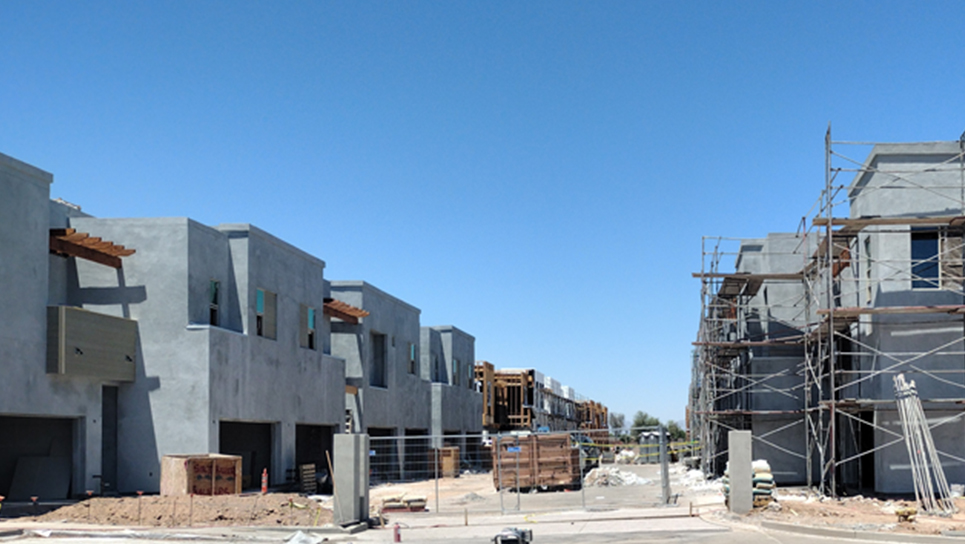
The Counter-Intuitive Truth: Today’s Challenges Create Tomorrow’s Opportunities
In a market experiencing widespread rent declines and elevated vacancy, suggesting now is the time to break ground on new build-to-rent projects might seem counterintuitive. But smart developers understand that real estate success isn’t about timing the market perfectly—it’s about positioning projects to deliver when fundamentals improve.
For BTR developers eyeing mid-2026 starts with 2027 deliveries and 2028 stabilization, the data tells a compelling story: the stars are aligning.
The Supply Equation Has Fundamentally Shifted
Researchers at Apartments.com/CoStar report, after record-breaking deliveries of 700,000 multifamily units in 2024, the construction pipeline has entered a dramatic slowdown. Supply additions dropped 30% in 2025 to 495,000 units, and the trajectory continues downward. More significantly, construction starts have plummeted 71% from their Q1 2022 peak of 210,000 units to just over 60,000 units in Q3 2025—well below pre-pandemic averages.
Phoenix exemplifies this trend, with projected deliveries expected to decline by 2.3% as a share of total inventory from 2025 to 2026. The supply wave that pressured rents throughout 2024 and 2025 has crested, and the pipeline behind it looks dramatically thinner.
The Timing Math Works
Consider the development timeline: A project starting in mid-2026 won’t deliver until 2027, with lease-up extending into 2028. By then, the market will have absorbed three years of declining new supply while demand fundamentals strengthen. According to CoStar’s research, national rent growth, currently hovering around 1%, is projected to accelerate to 1.9% by end of 2026. That figure is projected to approach 5% by 2027, says Cushman & Wakefield.
The gap between when oversupplied markets struggle and when a project delivers creates a critical advantage. Developers will be entering lease-up just as competition thins and demand strengthens.
The Renter-by-Choice Revolution
Perhaps the most significant shift is attitudinal. The typical first-time homebuyer is now 40 years old—the oldest on record—and first-timers represent just 21% of buyers, a historic low dating back to 1981. In Phoenix specifically, young professionals are delaying homeownership indefinitely as prices have stabilized but remain elevated.
More telling: Knightvest Capital’s 2025 Renter Sentiment Report reveals that 52% of renters no longer view homeownership as a status symbol, up from 45% the previous year. Roughly half express disinterest or neutrality about owning in the next five years. Only 53% say they’d be more likely to purchase even if interest rates drop—down dramatically from 70% in 2024.
This represents a fundamental cultural shift. Renting is no longer temporary housing; it’s a deliberate lifestyle choice. Nearly two-thirds of current renters have previously owned homes, demonstrating that affordability isn’t the sole factor. They’re choosing rental flexibility, lower maintenance responsibilities, and desirable locations over the commitment of homeownership.
BTR’s Competitive Advantage
Build-to-rent properties are uniquely positioned to capture this demographic. They offer the space, privacy, and neighborhood feel that appeals to those who might have bought in previous eras, combined with the maintenance-free lifestyle and flexibility today’s renters value.
Build-to-rent is emerging as a real bright spot in the alternative sectors. These properties – essentially single-family homes built specifically for rental – are thriving because homeownership remains out of reach for so many Americans. As supply pressures ease in this space, we’re seeing a nice recovery in both rents and occupancy levels. It’s worth noting that senior housing is also performing strongly with occupancy accelerating above 89% as the 75+ population grows.
As luxury apartments continue struggling with elevated vacancy—projected to remain above 10% even as overall vacancy falls—BTR communities serving the middle market will benefit from both strong retention and the growing pool of renter-by-choice households.
The overall picture? Multifamily sectors are benefiting from the same fundamental reality: people need somewhere to live, and buying a home just isn’t in the cards for a growing number of households. That’s created durable demand that looks set to carry through 2026, even as the market finds a more sustainable equilibrium after the construction boom of recent years.
The Bottom Line
Starting BTR projects in 2026 means delivering into a fundamentally different market than exists today. The supply glut is expected to have cleared, rent growth promises to be accelerating, and a generation of deliberate renters likely will be seeking exactly what BTR offers. The developers who recognize this inflection point and act now will be the ones reaping the rewards in 2028 and beyond.
In real estate development, the best time to plant a tree was yesterday. The second-best time is today—especially when you can see the forest thinning ahead.