
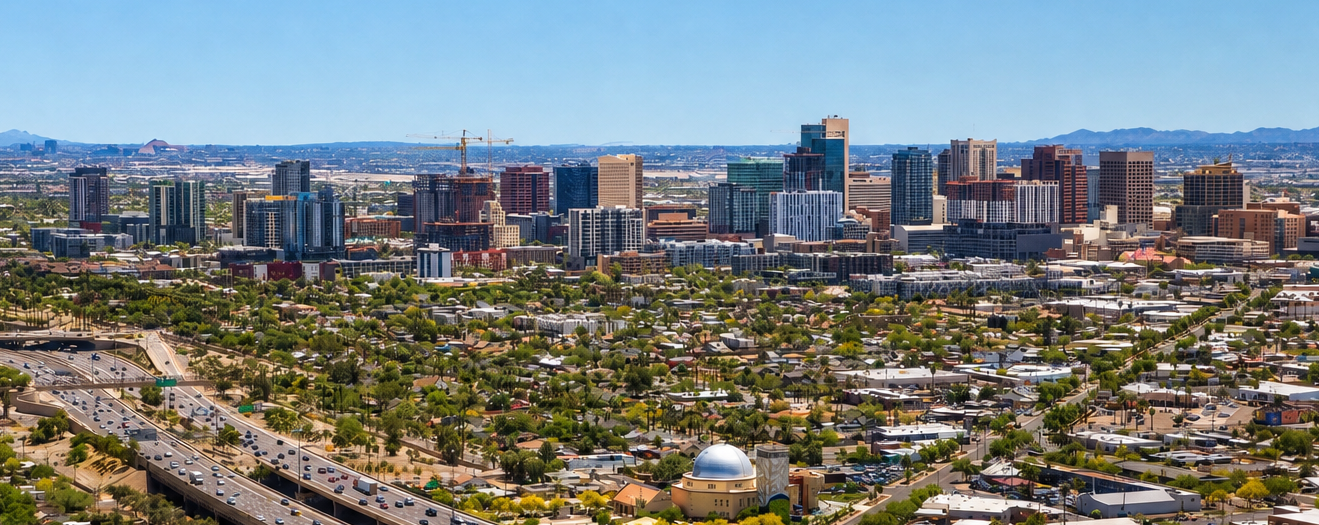
Phoenix’s growth story keeps finding new chapters. A national boomtown ranking, a nearly doubled semiconductor investment, a freshly approved $3 billion mixed-use megaproject in Mesa, and a citywide shift toward urban infill all point to a metro still firmly in expansion mode, even as the broader Arizona economy shows some of the uneven signals typical of this stage of the cycle.
Phoenix Cracks the Top 10 Boomtowns
Phoenix placed sixth among the nation’s top 50 metros for economic growth, one of only two top 10 metros located outside the Southeast, according to a new LendingTree ranking. The Valley’s strength showed up most clearly in work and earnings, third highest nationally, driven by 3.7% workforce growth, and in business and economy, where Phoenix ranked fourth behind only Seattle, Austin and San Jose, powered by 4.8% real GDP growth, the fourth highest in the country.
LendingTree researchers pointed out, “Phoenix’s growth is notable because there’s strength in both its workforce and its broader economy.” A separate Hines report recently named Phoenix among the metros best positioned to capture a share of a potential $1 trillion wave of advanced manufacturing construction investment nationally over the next decade, a trend already playing out on the ground.
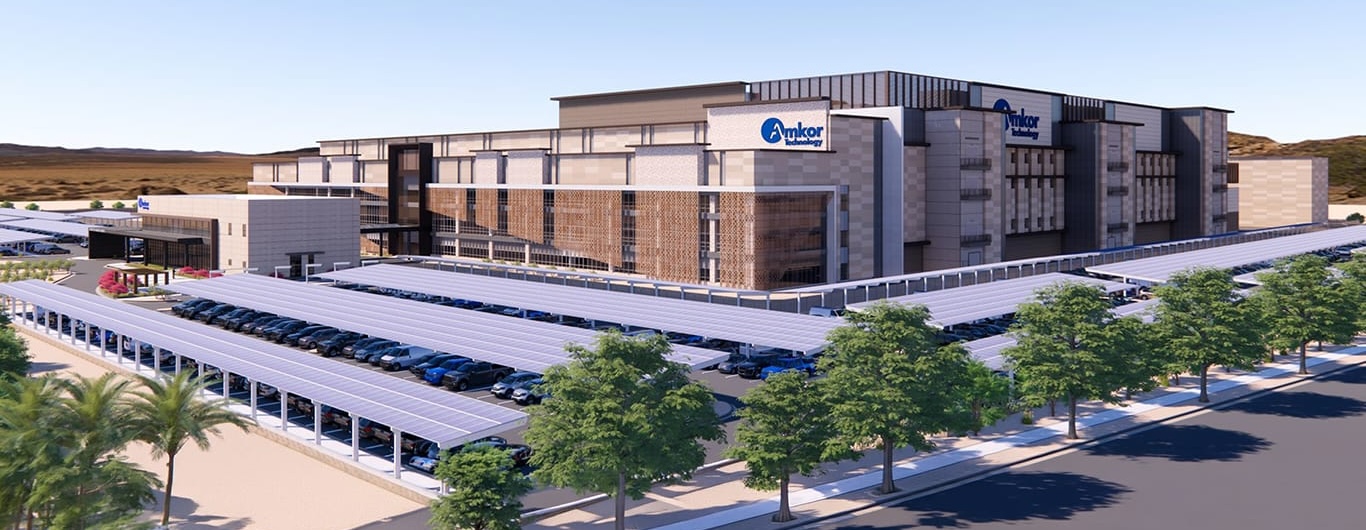
Amkor Nearly Doubles Its Peoria Investment to $12 Billion
That manufacturing momentum is concrete in Peoria, where Tempe-based Amkor Technology is increasing its investment in its advanced packaging and test facility from $7 billion to $12 billion, after customer demand exceeded the capacity allocated for phase one. The expansion adds 645,800 square feet of clean room space, pushing total capacity past 1 million square feet. The facility has already secured commitments from Apple and a 10-year agreement with Taiwan Semiconductor Manufacturing Co., with projected employment climbing from an original 3,000 jobs to more than 3,500.
Another Bright Spot: Mesa Approves the Largest Mixed-Use Project in Its History
Much has been written about the chip manufacturing sector’s accelerated growth, but there are other bright spots across the Valley of the Sun. Adding to the momentum, the Mesa City Council recently unanimously approved a development agreement for Legacy Park, a $3 billion, roughly 200-acre mixed-use development envisioned by Phoenix-based Vestar near Gateway Airport, the largest project in Mesa’s history. The plan includes a resort hotel, office towers, retail, a public lake and park, and multifamily housing, with construction slated to begin in 2028 and a first phase opening in 2029.
Why it matters: projects of this scale don’t get greenlit on short-term optimism. A $3 billion commitment with a 20-to-30-year buildout horizon reflects developer conviction that Southeast Valley growth is structural, not cyclical, reinforced by the project’s proximity to Gateway Airport, ASU’s Polytechnic campus and the Amkor-anchored manufacturing corridor taking shape nearby. City officials project the development will generate nearly $60 billion in economic output and create more than 20,000 jobs over its buildout, with tax revenue flowing back into parks, infrastructure and services valley wide. For a market where multifamily and BTR demand tracks closely with job creation and population inflow, a project of this size effectively pre-seeds decades of future housing demand in the surrounding submarket, long before the first building rises.
Growth Is Also Reshaping Itself from Within
Not all of Phoenix’s momentum is happening on the metro’s edges. Some of the most consequential change is unfolding in neighborhoods that have existed for decades, as aging commercial centers are being reimagined into places where residents can live, work and spend leisure time without a long commute. Properties like Paradise Valley Mall, Metrocenter, Fiesta Mall and Park Central Mall are being redeveloped into mixed-use districts rather than simply refreshed as retail, a shift accelerating across the Valley’s core neighborhoods.
Arizona’s recent housing legislation is helping drive that transition, making it easier for cities to permit accessory dwelling units and, in some areas, additional housing types on lots that historically supported only a single home. The changes won’t reshape neighborhoods overnight, but over time they expand housing options in places that already have the infrastructure, jobs and services to support them.
The appeal to residents for these reenvisioned centers is straightforward: walkability, restaurants, fitness studios and everyday services within a short walk or drive have become genuine value drivers, not just amenities. Younger buyers and empty nesters alike are gravitating toward this lifestyle, as they seek less home to keep up, while not sacrificing quality of life. That preference extends to a “lock and leave” mindset that now reaches well beyond retirees. Busy professionals and frequent travelers increasingly want a home they can secure and step away from. Some affluent buyers are choosing to rent for a period rather than buy, taking advantage of apartment incentives while they watch the for-sale market. That dynamic plays directly into the strength of the Valley’s apartment and BTR sectors.
The Takeaway
Between a top 10 growth ranking, a semiconductor manufacturer nearly doubling its Valley investment, a historic mixed-use approval in Mesa signaling decades of confidence in the Southeast Valley, and a genuine shift toward denser, more connected neighborhoods, Phoenix’s fundamentals continue to support the long-term investment case, even as the labor market, like much of the broader economy, works through a more uneven near-term stretch.