
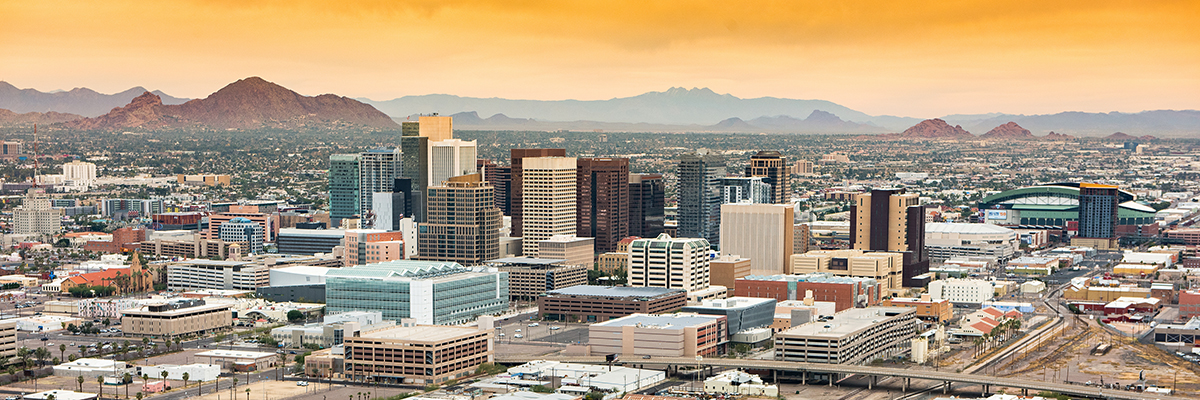
Phoenix remains one of the country’s most closely watched growth markets, and the latest data shows why. Capital keeps flowing in, more residents are on the way, and property fundamentals are strengthening as new supply gets absorbed. Apartment demand is setting records, industrial vacancy is well off its peak, and growing demand for skilled workers is a sign of how much opportunity the region is generating.

More People, Concentrated in the Valley
New projections from the Arizona Office of Economic Opportunity have the state growing from 7.72 million residents in 2025 to 9.75 million by 2060, a gain of about 2 million people, or 26%. Metro Phoenix is positioned to capture most of that growth. Maricopa County is projected to add more than 1.28 million residents, reaching 6.07 million, while Pinal County is on track to more than double to nearly 1.1 million.
The University of Arizona’s Economic and Business Research Center (EBRC) expects Arizona to keep outpacing the nation for decades to come, at about 0.8% a year. As the population matures, with residents 65 and older projected to rise from 22% to 29% by 2055, Arizona’s ability to attract newcomers will be the driver of future growth.
An Economy That Outperforms
EBRC describes the economy as resilient. Arizona added 23,600 jobs over the year through June, up 0.7% against flat job growth nationally. EBRC forecasts job growth of 0.7% this year and 1.0% in 2027. Consumers are still spending, and local shelter costs rose just 1.4%, versus 3.3% nationally, which keeps the Valley affordable relative to the rest of the country.
Real Estate Fundamentals Are Strengthening
Industrial leads the way. In Q3 2026, average asking rents rose 9.0% from a year earlier, net absorption totaled 1.59 million square feet, and vacancy has fallen 300 basis points from its Q1 2025 peak of 12.7%. Investors are staying engaged too. Phoenix industrial sales topped $1 billion for an eighth straight quarter in Q2, at roughly $1.1 billion. Marcus & Millichap places Phoenix No. 7 on its National Industrial Property Index.
Apartments are turning a corner. Net absorption reached 12,741 units in the first half of 2026, the strongest six-month span since at least 2000. Demand has outpaced new deliveries so far this year, pulling vacancy lower and allowing modest rent growth in each of the first two quarters.
Office and retail are also improving. Kidder Mathews reports that Phoenix office vacancy edged lower in Q3 2026, rents rose, and absorption turned modestly positive. Retail is tight: Marcus & Millichap projects year-end 2026 vacancy of 5.2%, with asking rents up 3.2%, and nearly 90% of the 2.8 million square feet delivering this year is already preleased.

Manufacturing, Tech and Data Centers Keep Pulling Capital
The Arizona Commerce Authority ranks the state first in the nation for semiconductor investment since 2020, with more than $319 billion announced and TSMC’s commitment now at $265 billion. Manufacturing employment grew 10% from 2020 to 2025, more than double the national rate.
Data centers are adding to the pull. According to local reports, logistics firms and contractors serving data center developers are snapping up West Valley industrial space, with DHL alone leasing more than four million square feet this year. Arizona ranks fifth among states for data center capacity, per JLL. As the sector scales, developers are working through power timelines and local zoning, which are the kinds of challenges that come with a market this in demand.
The Workforce Squeeze
Hiring is the constraint. In semiconductors, a Helios Education Foundation study found that Arizona schools award about 25,290 relevant credentials a year, but only 4,300 of those graduates end up working in the sector. Construction faces its own shortage across nearly all major skilled trades, from electricians and plumbers to HVAC technicians and equipment operators.
Multifamily Supply Is Moving Toward Balance
A recent Mark-Taylor Companies report shows the Phoenix multifamily market moving toward a healthier supply-and-demand balance. After several years of elevated deliveries, new construction is falling, absorption is improving and excess inventory is steadily shrinking.
Phoenix has absorbed more apartment units than were delivered for six consecutive months. In August, roughly 1,614 units were absorbed against 1,265 deliveries, a 128% rate. Excess inventory has fallen 37%, from a peak of about 11,200 units in April 2025 to 7,084, and of the 87,673 units delivered since 2021, 86% are occupied. Excess remains most concentrated in Southwest Phoenix (27%) and Downtown, Midtown and Uptown (17%).
Supply is easing. Rolling 12-month deliveries peaked at 23,624 units in April 2025 and have since slowed to 17,119, and Phoenix is projected to deliver about 15,800 units in 2026, down from 19,862 in 2025. About 24,600 units remain under construction through 2028, down 41% from nearly 41,700 a year ago. Deliveries are still expected to average about 1,400 units a month through April 2027, so absorption needs to stay elevated, and a sharper fourth-quarter slowdown could delay recovery. Mark-Taylor expects lower-supply submarkets, led by North/Central Phoenix and Camelback and South Scottsdale, to recover first in 2027, with a broader recovery through 2028 and Southwest Phoenix likely lagging longest.
Our Perspective
These trends reinforce our longer-term outlook for the Phoenix rental market. The market is still absorbing recent deliveries, but expensive ownership, with the median single-family price near $450,000 since late 2025, continues to sustain renter demand while the pipeline shrinks. With fewer projects moving into construction and trades short on workers, we believe well-located communities with differentiated rental products will be particularly well positioned as the market normalizes. Despite the challenges, the Phoenix market remains in growth mode, albeit at a slightly more moderate pace.