
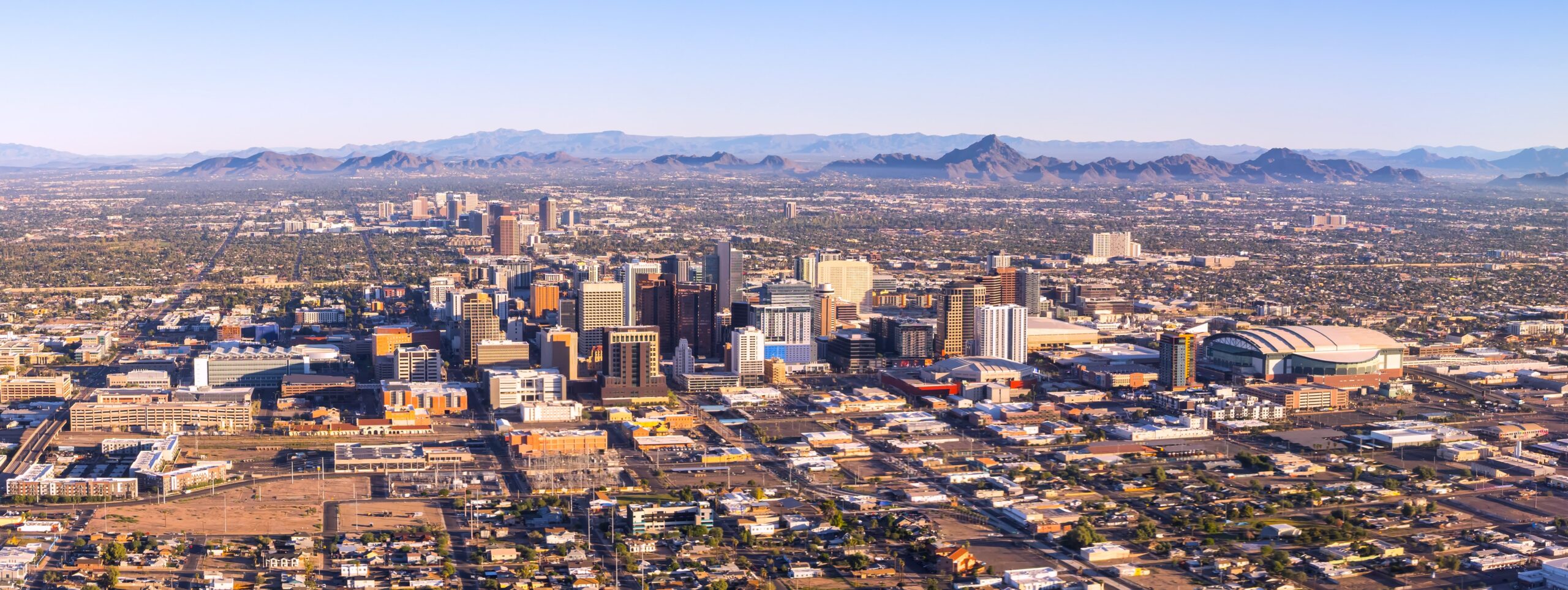
Phoenix’s apartment market is turning a corner. CoStar named the metro one of the 10 most improved multifamily markets in the country this year, a notable shift for a market that spent the last two years working through oversupply.
Vacancy fell from 12.3% to 11.7% year-over-year, and CoStar projects it will keep sliding, to 10% in 2027 and 9.5% by 2028. The supply-demand balance, which sat at negative 1.6% a year ago, has flipped positive to 0.1%. Rent growth momentum improved too, moving from -1.5% to -0.2%, with CoStar forecasting positive rent growth starting in the second quarter. The average one-bedroom still runs about $1,300, roughly 22% below the national average, giving Phoenix room to run before affordability becomes a ceiling.
The build-to-rent and single-family rental sector is telling a complementary story nationally. Cotality’s latest Single-Family Rent Index shows spring leasing season rents climbing 2.2% between February and May, outpacing the 1.9% gain over the same stretch last year, even as annual rent growth cooled to 1.3% from 2.6% a year ago. The regional split is notable for Sun Belt watchers: Houston and Dallas posted annual rent declines, part of a broader pattern of 13 large metros (seven of them in Florida) seeing rents fall year-over-year. Phoenix’s improving fundamentals stand out against that backdrop rather than tracking it, reinforcing that this looks like a market-specific recovery, not just a regional tailwind.
The construction pipeline is thinning out, which is credited for much of the heavy lifting. That’s playing out at the national level too: Commerce Department data shows single-family starts and permits pulling back for a third straight month under the weight of elevated mortgage rates, even as multi-family starts (5+ units) jumped over 76% for the month and 19.3% year-over-year, builders leaning into rental product as the for-sale market cools. Northmarq reported new deliveries fell nearly 25% in the first quarter to about 1,800 units, and the share of inventory under construction dropped from 6.6% to 4% year-over-year. That said, roughly 26,000 units remain under construction, with close to half slated to deliver before the end of 2026, so competitive pressure in the Valley isn’t gone, just easing.

Phoenix Economic Development Hits Record High, Fueled by Semiconductor Boom.
Arizona just closed its most successful year for economic development on record. The latest Arizona Commerce Authority annual report showed companies announced more than $109 billion in new investment across the state between July 2025 and June 2026, nearly triple the prior year’s $31 billion, with projected job creation reaching over 26,000. The pipeline remains deep too: ACA reports 483 active projects representing $104 billion in future investment and 122,000+ potential jobs, with manufacturing driving the bulk of that activity.
Phoenix landed 14th among the top 20 tech metros in the Western U.S. in CommercialCafe’s latest ranking, a list still dominated by Bay Area heavyweights, but one where Phoenix punches above its weight on growth. The metro ranked 5th for tech establishment growth (up 11.5% from 2020 to 2023), 7th for organizations contributing to patent activity, and 8th for total tech patents granted over a five-year span. That’s the profile of a market building a durable tech employment base, not just riding a single company’s momentum.
Semiconductors remain the clear engine. TSMC’s north Phoenix campus recently drew an additional $100 billion commitment, pushing its total Arizona investment to $265 billion. That anchor tenant continues to pull suppliers into the Valley, Amkor tripled its Peoria packaging facility investment to $7 billion, ASML opened a North American training facility near Sky Harbor, and Applied Materials launched a $270 million R&D facility with ASU in Chandler.
Beyond chips, the growth is broad-based: Hadrian’s $200 million aerospace facility in Mesa, Burlington’s two-million-square-foot distribution center in Buckeye, and even Buc-ee’s first Arizona location, are all signals of a market still accelerating on multiple fronts.
That infusion of investment capital doesn’t stay contained to one campus or company. It shows up in construction jobs, supplier networks, and eventually rooftops. It’s also showing up in the migration data already. While several Sun Belt migration darlings are cooling, Tampa’s domestic inflow dropped 70% year-over-year, Atlanta flipped to a net population loss, Phoenix’s net domestic inflow actually rose, from about 19,400 to 21,400. Maricopa County added roughly 57,500 residents, the fifth-largest county-level gain in the nation.
Put together: a market absorbing its supply overhang faster than expected, a tech employment base with real growth legs, and a $100 billion anchor tenant doubling down on Arizona. For BTR developers watching for the next markets where fundamentals and job growth are lining up at the same time, Phoenix is positioned as one to continue pursuing.
The real story, though, is what’s underneath the numbers: jobs, and specifically tech.
Phoenix landed 14th among the top 20 tech metros in the Western U.S. in CommercialCafe’s latest ranking, a list still dominated by Bay Area heavyweights, but one where Phoenix punches above its weight on growth. The metro ranked 5th for tech establishment growth (up 11.5% from 2020 to 2023), 7th for organizations contributing to patent activity, and 8th for total tech patents granted over a five-year span. That’s the profile of a market building a durable tech employment base, not just riding a single company’s momentum.
Except there is a single company doing an outsized amount of that momentum-building: TSMC. The chipmaker just committed another $100 billion to its North Valley campus, bringing total investment there to roughly $265 billion, likely funding four additional fabrication plants capable of producing 2-nanometer and smaller chips, plus more advanced packaging capacity. The expansion news landed alongside a blowout second quarter: TSMC posted $40.2 billion in revenue, up 36% year-over-year, and net income up 77%, its fifth straight record quarter, fueled by AI-driven demand for leading-edge chips. Company leadership has been direct about the “why,” AI computation needs are only accelerating, and Arizona is now central to meeting them.
That kind of capital commitment doesn’t stay contained to one campus. It shows up in construction jobs, supplier networks, and eventually rooftops. It’s also showing up in the migration data already. While several Sun Belt migration darlings are cooling, Tampa’s domestic inflow dropped 70% year-over-year, Atlanta flipped to a net population loss, Phoenix’s net domestic inflow actually rose, from about 19,400 to 21,400. Maricopa County added roughly 57,500 residents, the fifth-largest county-level gain in the nation.
Put together: a market absorbing its supply overhang faster than expected, a tech employment base with real growth legs, and a $100 billion anchor tenant doubling down on Arizona. For BTR developers watching for the next markets where fundamentals and job growth are lining up at the same time, Phoenix is positioned as one to continue pursuing.