
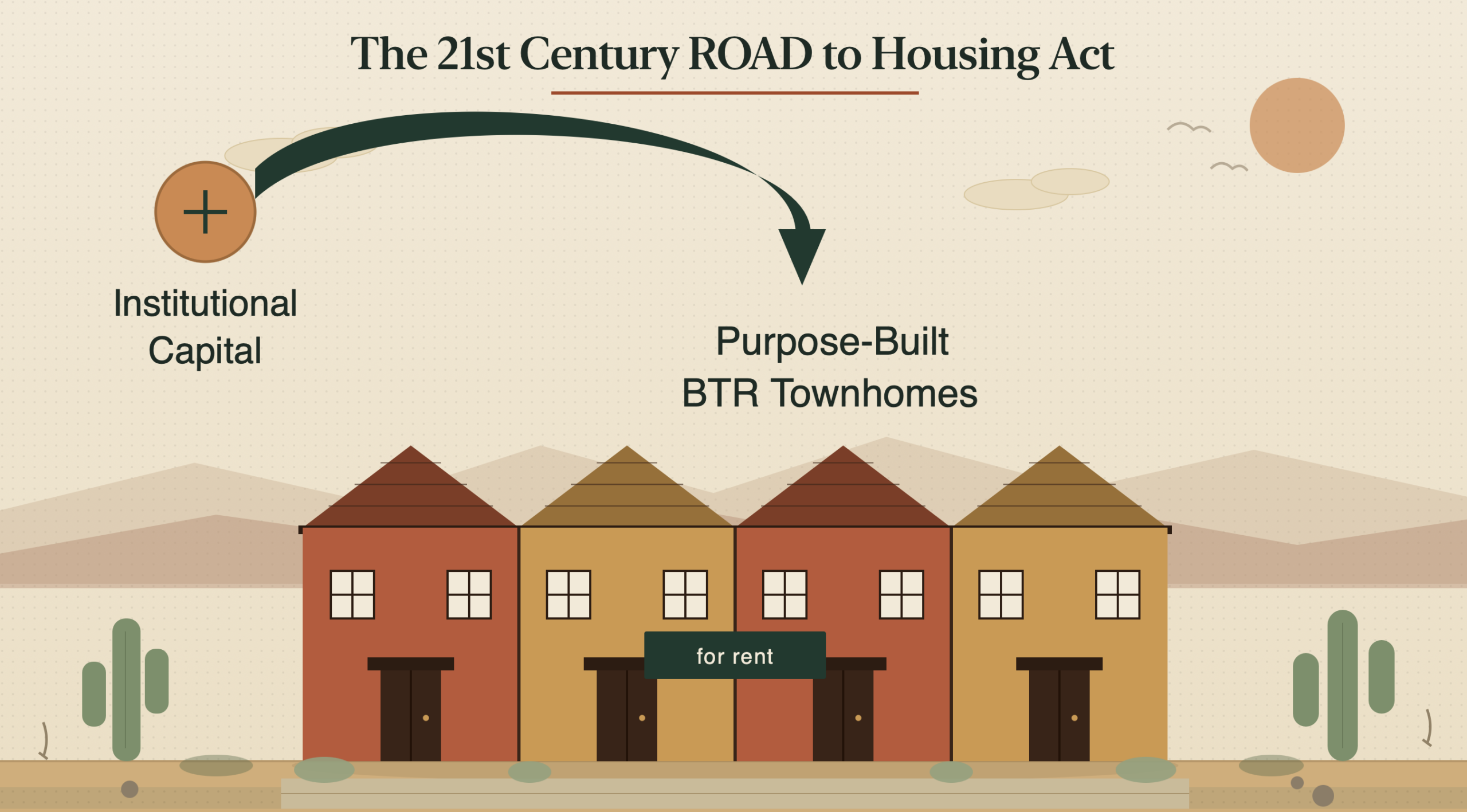
The 21st Century ROAD to Housing Act became law at midnight on July 11, 2026. What matters for CRE about this legislation is this is the most significant federal housing package in roughly three decades, and it landed with rare bipartisan force. The package advances major reforms to modernize federal housing programs, streamlines environmental reviews, reduces barriers to construction, supports manufactured housing, builds more homes in Opportunity Zones, encourages transit-oriented development, and promotes local zoning and land-use reforms.
For build-to-rent developers specifically, the headline isn’t the bill’s passage. It’s what got stripped out before it passed.
The Fight that Mattered
Earlier drafts would have forced BTR developers to sell off their homes to individual buyers within seven years, a provision the industry warned would have gutted new BTR construction entirely, since these projects are financed and structured as long-term rental assets, not for-sale inventory. That forced-sale mandate is gone from the final law. In its place: a cap limiting large institutional investors to 350 single-family homes, with homes built specifically as rentals exempted from that cap.
That carve-out effectively redirects the institutional capital that used to flow into scattered-site single-family acquisitions toward purpose-built BTR communities instead. Experts are convinced BTR is now the clearest remaining pathway for institutional capital that wants exposure to single-family rental demand. Rather than competing with individual buyers for existing homes, that capital gets pushed into building new supply.
The early market reaction backs that up. Developers pipelines, which had stalled when the forced-sale provision was still on the table, are moving again, And outlooks are ramping up rather than holding steady, citing improved visibility on the supply side.
What it Might Mean for CRE
For commercial real estate broadly, the law’s clearest signal is that Washington is treating housing supply as an economic priority again, and BTR sits in a favored position within that shift. Several provisions work together to make new rental construction more feasible, not just more politically favorable. Streamlined federal environmental review under NEPA cuts holding costs and timeline risk on new projects.
A raised cap on how much banks can put into public welfare investments is expected to increase demand, and pricing, for low-income housing tax credits, generating more equity for affordable and mixed-income development. A $200 million innovation fund rewards jurisdictions that adopt pro-housing zoning and permitting reforms, which could gradually open up more BTR-friendly land in markets that have historically restricted it. None of these are BTR-specific, but all of them lower the cost and friction of building rental housing at the same moment institutional capital is being steered toward exactly that.
Where that capital lands will vary by market. The effect should be most visible in metros where institutional investors already hold large scattered-site single-family portfolios and rental fundamentals are healthy enough to support new construction, Atlanta, Jacksonville and Indianapolis are some of the names coming up most often. Atlanta looks like an early bellwether: institutional investors control close to 30% of the metro’s single-family rental homes, and more than 6,800 BTR homes were already under development there last year, with the pace of new activity roughly doubling year-over-year even before the law passed. By contrast, markets that got overbuilt during the pandemic, like Austin, are seeing less institutional appetite regardless of the new rules, existing owners there are underwater on rent-to-mortgage math and in no position to deploy fresh capital into anything new.
The underlying logic is straightforward: capital that would previously have competed with individual buyers for existing homes now has a clearer, friendlier lane into new construction instead. Rental experts point out every rental home built is one less home available to a buyer, but for CRE investors and developers, that tension is exactly what makes BTR the preferred structure going forward. Clearly more supply is needed in both buckets. The legislation sidesteps the political and regulatory pressure building around institutional single-family ownership while still giving capital a way to participate in single-family rental demand. Expect institutional partners, BTR platforms and merchant developers to lean further into forward-sale and joint-venture structures over the next several quarters as that capital repositions.
The institutional investor restrictions don’t take effect for six months, and they sunset after 15 years. Most of the supply-side provisions require HUD rulemaking before they’re operative at all, meaning the practical effects could take years to show up fully in deal flow, but the capital allocation shift appears to already be underway.
The Caveat that Matters Most
Industry leaders are framing this as directionally important rather than transformative. NMHC President Sharon Wilson Géno described the law’s impact as “a deal here or a deal there” rather than a wholesale reset of the housing market. Most of the barriers to production still sit with local zoning and permitting authority, which Washington has limited power to touch. National housing experts note the bill is not a silver bullet, and the structural affordability challenges facing the lowest-income renters remain largely unaddressed.
Still, for an institutional capital base that had been sitting on the sidelines waiting to see how the forced-sale fight would resolve, the removal of that provision is a real green light. Combined with a shrinking single-family construction pipeline and mortgage rates keeping would-be buyers in the rental pool, the policy landscape is now tilted in build-to-rent’s favor in a way it wasn’t six months ago. The question for the next 12 to 18 months isn’t whether institutional capital returns to single-family rental, it’s how much of it lands in ground-up BTR versus waiting on the sidelines for HUD to finish writing the rules.